How Long Do Leftovers Last in the Fridge?

Last reviewed: October 11, 2026.
Key takeaways
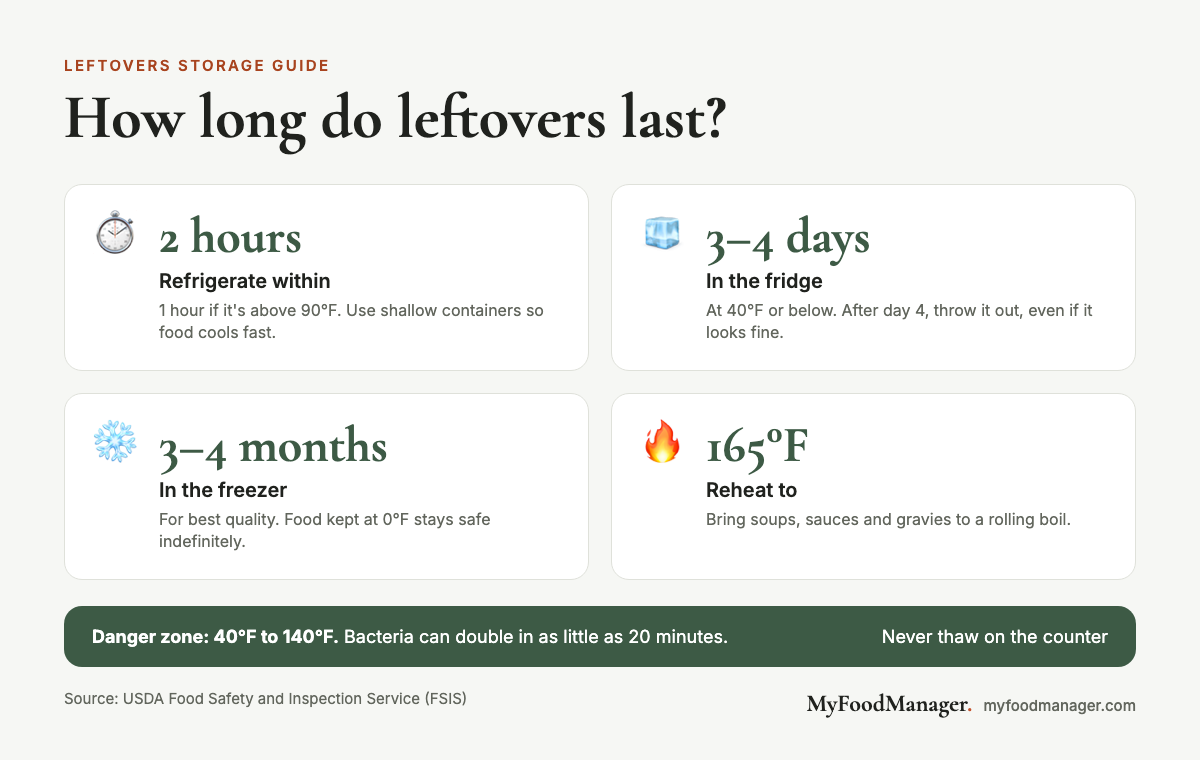
- 3 to 4 days in the fridge, 3 to 4 months in the freezer is the USDA guideline for cooked leftovers.
- The 2-hour rule: refrigerate leftovers within 2 hours of cooking, or within 1 hour when the air is above 90°F (a picnic, a hot car).
- Cool it fast: divide big batches into shallow containers so the middle chills quickly.
- Reheat to 165°F, and bring soups, sauces and gravies to a rolling boil.
- Frozen food kept at 0°F stays safe indefinitely. The 3-to-4-month window is about taste and texture, not safety.
- Write the date on the container. “I think that’s from Sunday” is how good food gets thrown out, or bad food gets eaten.
Why 3 to 4 days?
The bacteria that cause food poisoning don’t announce themselves. Leftovers can look fine and smell fine and still make someone sick, so you can’t judge them by eye or nose. Refrigeration slows bacteria down but doesn’t stop them, which is why the USDA puts a time limit on cooked food rather than telling you to trust your senses (USDA FSIS, Leftovers and Food Safety).
The danger zone is 40°F to 140°F. In that range, bacteria can double in as little as 20 minutes (USDA FSIS, “Danger Zone” (40°F - 140°F)). Everything below follows from keeping food out of that range as much as possible: cold quickly, cold consistently, then hot all the way through when you eat it.
Your fridge needs to be doing its part, too. The USDA says it should be set at 40°F or below, and the freezer at 0°F (USDA FSIS, Freezing and Food Safety). A cheap fridge thermometer is the only way to know; the dial inside most fridges is a setting, not a reading.
How to store leftovers safely, step by step
- Put them away within 2 hours. Start the clock when the food comes off the heat or out of the oven, not when dinner ends. If it’s hotter than 90°F where the food is sitting, you have 1 hour. Leftovers that sat out longer should be thrown away.
- Use shallow containers. A deep pot of chili can stay warm in the middle for hours, even in the fridge. Split big batches into shallow containers so they cool quickly. It’s fine to put warm food straight into the fridge.
- Cover and label. Wrap or seal the food, and write the date on it. Masking tape and a marker work fine.
- Decide fridge or freezer right away. If you know you won’t eat it within 3 to 4 days, freeze it now, while it’s at its best, instead of on day 4.
- Eat or toss by day 4. Anything older goes in the trash, even if it looks fine.
Freezing leftovers
Freezing is the easiest way to stretch a big batch without stretching your luck. The USDA’s guidance for frozen leftovers is 3 to 4 months for best quality. Food kept constantly at 0°F will always be safe; only the quality suffers with long storage (USDA FSIS, Freezing and Food Safety). So the forgotten container from last winter isn’t dangerous; it just may not taste like much.
A few habits make frozen leftovers worth eating:
- Freeze in portions you’ll actually use: single lunches, or a dinner for the household.
- Squeeze out the air from bags and leave a little headroom in containers for liquids to expand.
- Label with what it is and the date. Frozen chili and frozen pasta sauce look alike.
Thawing frozen leftovers
The USDA lists three safe ways to thaw (USDA FSIS, Leftovers and Food Safety):
| Method | How | Can you refreeze it? |
|---|---|---|
| In the refrigerator | Move it from the freezer a day ahead | Yes. Use within 3 to 4 days, or refreeze |
| In cold water | Sealed bag submerged in cold water | Only after cooking it |
| In the microwave | Use the defrost setting | Only after heating it to 165°F |
Don’t thaw leftovers on the counter. The outside sits in the danger zone long before the middle thaws.
Reheating leftovers
Reheat leftovers until they reach 165°F, measured with a food thermometer, or until hot and steaming. Bring sauces, soups and gravies to a rolling boil (USDA FSIS, Leftovers and Food Safety).
In the microwave, cover the food and stir or rotate it partway through, because microwaves heat unevenly and leave cold spots. Use a covered, microwave-safe glass or ceramic dish, and add a splash of liquid if the food looks dry.
Don’t reheat leftovers in a slow cooker. It warms food too slowly and leaves it in the danger zone too long. Reheat on the stove or in the microwave first; a slow cooker is fine for keeping food hot once it’s already hot.
If you only eat part of a container you reheated, the USDA says you can safely refreeze what’s left of previously frozen leftovers, as long as you heated them to 165°F.
Restaurant and takeout leftovers
The same rules apply to the box you bring home from a restaurant, with one catch: the 2-hour clock started when the food was served, not when you got home. If dinner was long and the drive is longer, or the box sat in a hot car, it may already be close to the limit (USDA FSIS, Safe Handling of Take-Out Foods). Go straight home and put it in the fridge.
For a specific food, check FoodKeeper
The 3-to-4-day guideline is for cooked leftovers in general. For individual foods, from deli meat to cooked rice to opened sauces, the USDA’s free FoodKeeper tool lists fridge, freezer and pantry times (FoodSafety.gov, FoodKeeper App). It’s worth a bookmark.
Make leftovers part of the plan
The best way to keep leftovers from going bad is to plan to eat them. Cook once, eat twice: make enough on Sunday for Tuesday’s lunch, and write it down so it doesn’t become a mystery container. Our guide to meal planning on a budget shows how to build leftover nights into a week, and a simple pantry inventory helps you spot what needs using up before you shop.
MyFoodManager helps with both: you can mark planned leftovers on your meal plan, and your pantry flags items to use soon. Start free.
Frequently asked questions
How long are leftovers good for in the fridge?
Three to four days, according to the USDA. That applies to cooked leftovers stored in the refrigerator at 40°F or below. After day 4, throw them out, even if they look and smell fine.
How long can leftovers sit out before you refrigerate them?
No more than 2 hours at room temperature, or 1 hour if the temperature is above 90°F. Leftovers left out longer than that should be thrown away.
Can you put hot food straight into the fridge?
Yes. You don’t need to let food cool on the counter first. To help it cool quickly, divide large amounts into shallow containers before refrigerating.
How long do leftovers last in the freezer?
For best quality, eat frozen leftovers within 3 to 4 months. Food kept frozen at 0°F stays safe indefinitely, but the taste and texture decline the longer it’s stored.
What temperature should you reheat leftovers to?
Reheat leftovers to 165°F, checked with a food thermometer, or until they’re hot and steaming. Bring soups, sauces and gravies to a rolling boil.
Is it safe to reheat leftovers more than once?
The USDA says it’s safe to refreeze what remains after you reheat previously frozen leftovers to 165°F. Each round of cooling and reheating costs some quality, so it’s better to reheat only the portion you’ll eat.